How to Start a Business in Luxembourg in 2026: Complete Step-by-Step Guide
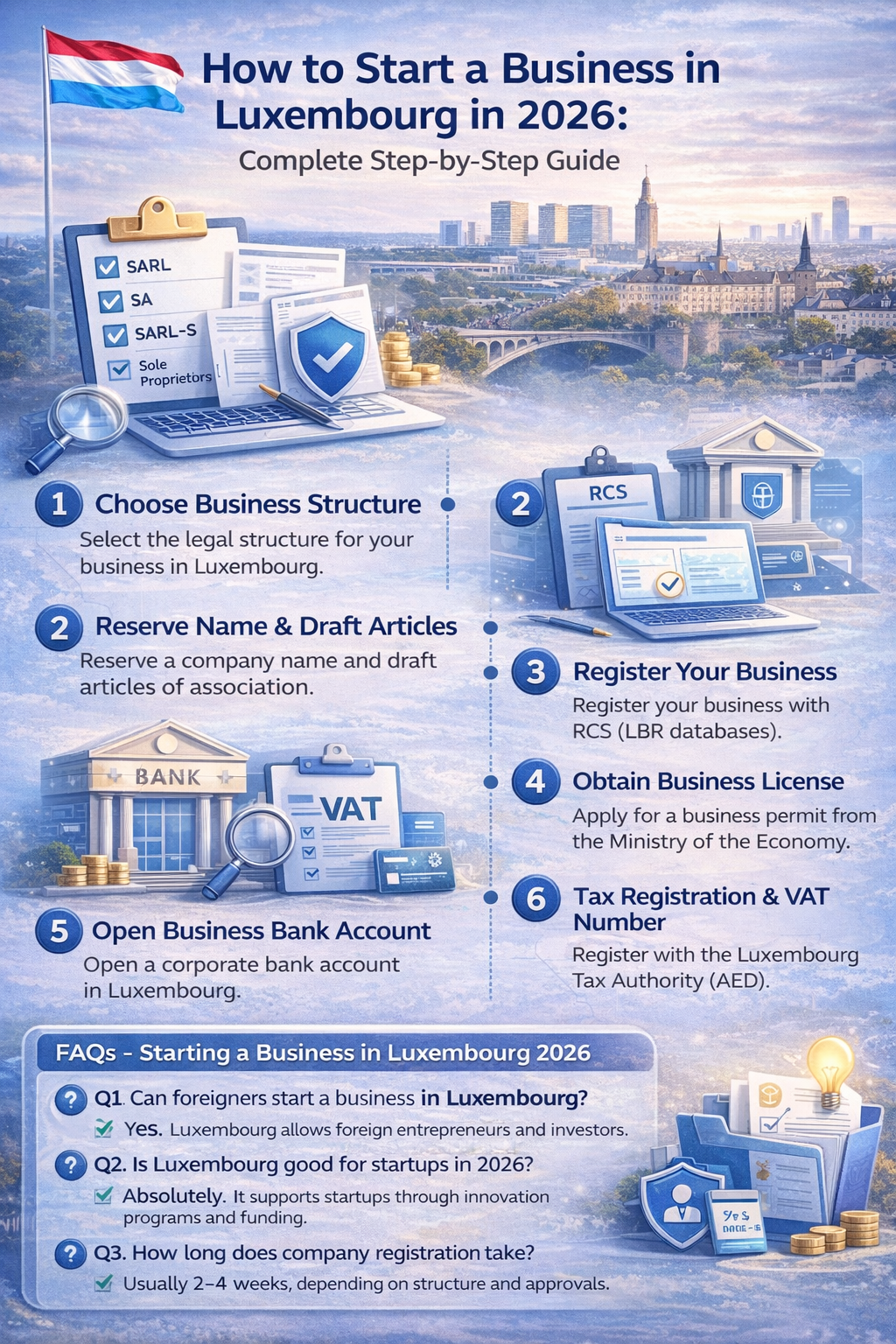
How to Start a Business in Luxembourg in 2026: Complete Step-by-Step Guide
Luxembourg continues to be one of Europe’s most attractive destinations for entrepreneurs, startups, fintech companies, and international investors. With its business-friendly regulations, strategic EU location, tax advantages, and strong financial ecosystem, starting a business in Luxembourg in 2026 offers excellent growth opportunities.
This complete guide explains how to start a business in Luxembourg in 2026, including legal structures, registration steps, costs, taxes, licenses, and compliance requirements.
Why Start a Business in Luxembourg in 2026?
Luxembourg consistently ranks among the top countries for ease of doing business due to:
-
Stable economy and political environment
-
Access to the European Union single market
-
Strong banking, fintech, and financial services ecosystem
-
Attractive corporate tax framework
-
Support for startups, innovation, and foreign investors
In 2026, Luxembourg remains a preferred hub for fintech, SaaS, blockchain, investment funds, e-commerce, and consulting businesses.
Step 1: Choose the Right Business Structure in Luxembourg
Selecting the correct legal structure is the first and most important step.
Common Business Structures in Luxembourg
1. SARL (Private Limited Company)
-
Most popular structure
-
Minimum capital: €12,000
-
Suitable for startups and SMEs
2. SA (Public Limited Company)
-
Minimum capital: €30,000
-
Ideal for large businesses and investors
3. SARL-S (Simplified SARL)
-
Minimum capital: €1
-
Designed for startups and solo entrepreneurs
4. Sole Proprietorship
-
Simple setup
-
Unlimited personal liability
Step 2: Reserve Company Name & Draft Articles of Association
-
Choose a unique company name
-
Draft Articles of Association
-
Notarization is required for SARL and SA companies
This step legally defines your company’s objectives, management structure, and shareholding.
Step 3: Register Your Business in Luxembourg
You must register your company with:
-
RCS (Registre de Commerce et des Sociétés)
-
Luxembourg Business Registers (LBR)
Once registered, your business officially exists and can operate legally in Luxembourg.
Step 4: Obtain Business License (Autorisation d’Établissement)
Most businesses require a business permit issued by the Ministry of the Economy.
To obtain it, you need:
-
Proof of professional qualifications
-
Clean criminal record
-
Business address in Luxembourg
This step is mandatory for most commercial and service activities.
Step 5: Open a Business Bank Account
A corporate bank account in Luxembourg is required to:
-
Deposit share capital
-
Manage company finances
-
Comply with AML and KYC regulations
Luxembourg banks conduct strict due diligence, especially for fintech and international businesses.
Step 6: Tax Registration & VAT Number
Register your business with:
-
Luxembourg Tax Authority (AED)
-
VAT registration (mandatory if turnover exceeds threshold)
Luxembourg offers competitive corporate tax rates while maintaining strong compliance standards.
Step 7: Hire Employees & Social Security Registration
If you plan to hire staff:
-
Register with CCSS (Centre Commun de la Sécurité Sociale)
-
Comply with labor laws and payroll obligations
Luxembourg has a skilled multilingual workforce, making it ideal for international businesses.
Compliance & Ongoing Requirements in 2026
Businesses in Luxembourg must comply with:
-
Corporate governance rules
-
Annual financial reporting
-
GDPR data protection laws
-
AML & KYC regulations
-
Sector-specific compliance (fintech, finance, crypto)
Cost to Start a Business in Luxembourg (2026)
Approximate costs:
-
Company formation: €1,500 – €4,000
-
Notary & registration: €1,000 – €3,000
-
Share capital: €1 – €30,000 (depending on structure)
Costs vary based on business type and compliance complexity.
Advantages of Starting a Business in Luxembourg
-
Access to EU markets
-
Strong investor confidence
-
Startup-friendly ecosystem
-
Reliable legal and tax system
-
Ideal for fintech and financial services
Conclusion
Starting a business in Luxembourg in 2026 is a smart move for entrepreneurs seeking stability, global access, and regulatory clarity. With the right structure, proper licensing, and full compliance, Luxembourg offers a strong foundation for long-term success.
Whether you’re launching a startup, fintech company, or international venture, Luxembourg remains one of Europe’s most strategic business destinations.
FAQs – Starting a Business in Luxembourg 2026
Q1. Can foreigners start a business in Luxembourg?
Yes, Luxembourg allows foreign entrepreneurs and investors.
Q2. Is Luxembourg good for startups in 2026?
Absolutely. It supports startups through innovation programs and funding.
Q3. How long does company registration take?
Usually 2–4 weeks, depending on structure and approvals.
- Website Development services delhi ncr near me
- Google Expert In Greater Noida
- GMB SEO Expert in Noida – Rank Your Business in Top 3 on Google Maps
- GMB SEO Expert in Ghaziabad – Rank in Top 3 on Google Maps near me
- Boost Your Local Business with SEO in Noida, Greater Noida & Ghaziabad – SSB Digital India


Get In Touch
Centre Gaur Chowk, LG-35, Gaur City, West, Sector 4, Greater Noida, Uttar Pradesh 203207
+91 9315-814-211 | 8377014621 | 8377014691 | 7088091951
info@ssbdigitalindia.com
Quick Links
Home About Us Our Services Contact Us Privacy & Policy Refund & Cancellation Policy Terms and ConditionsPhoto Gallery